Burning
Norma Gay Prewett
Like Elaine Benes of Seinfeld fame, I once sneaked a peek at my own medical records left lying on the examining table. One doc’s remark began, “This interesting lady presents with …” (and the gory details followed). I know what “interesting” is code for—it is a way of saying “whack job.” But I use interesting in the sense of eccentric and quirky in a very good way, as Kurt Vonnegut once said, “like a girl with one blue eye and one brown.”
My interesting mother died four years ago this year, 2010, on my 56th birthday, April 23rd. Actually, my six sisters claim that she waited to die until one minute after midnight in kindness to me, and that sounds like my mother. But what my sisters don’t know is that I like the perfect circle circumscribed by her dying, if death be necessary, on my birthday. I look so much like her that my father, in his last days, sometimes mixed us up and thought he was talking to her, and I have begun to take on her eccentricities, which were many, so it is fitting that our lives coalesce in this way. Nobody can take that away from me.
My mother had a closetful of superstitions and individualizing traits—she could be a clown, play practical jokes, build odd things out of spare parts, but what I think may have been her most unusual trait was her need to burn—to burn with a clear and purposeful flame anything that annoyed her. She could clear whole swaths of paper goods, for example, if she suspected unwholesome introversion. I shall always wonder whether the day she “cleaned” my little desk in my room (okay, my shared room since I never had a room all to myself until after college for about three months) was the day my particular muse music died for the first time—whether those early soulful poems were my very best, the work of a thirteen-year-old genius of epic proportion—instead of the moody maunderings of a pimply malcontent.
Many was the late Fall or early Spring day when the school bus (actually driven by my dad, but ours was not the last stop) lumbered up our lonely gravel road through billows of both dust and smoke which, much to my everlasting shame, cleared just enough to reveal my mother’s bearish form—dressed in Daddy’s overalls and a tatty sweatshirt, hoisting a rake or shovel to greet Dad. She would be burning the side ditches, a fairly common country sport, which I now know promotes good growth the next year, but for her was just satisfying in every way. If a new broom sweeps clean, a new burn burns really clean, clearing away ambiguity and messiness. Even today, my sisters and I tell each other about our cleaning projects by using the phrase “going all Bonnie on it.” Hers was a literal scorched earth policy.
She burned things that were not ordinarily considered flammable. The epitome of this arsonist’s heart of hers may be represented by the day I came home from school and found Mama dismantling the cook stove. This time, she wasn’t just in a cleaning frenzy either. She took off everything that easily detaches—burners, burner pans, knobs, hardware—and tossed it out the back door. Then, she got the axe. I am quite convinced my mama had an excess of testosterone, and, except for when she fell on ice carrying a full chamber pot (yes, I was born in the 20th Century but we did live in a cold old, unplumbed rental farmhouse until I was nine) and slipped a disc in her back, was strong like bull. About five feet tall and maybe 150 pounds, she had worked out by working—toting full tubs of water for bathing and laundry, heavy wet clothes back and forth to lines, and anything else she took a notion to pull, push, or carry.
Then, axe in hand like some mad suffragette, Mama Bonnie dragooned as many of us children as were within catching distance. We were put to work finishing off the stove like a pack of jackals on a carcass. Mom was probably chewing her tongue and muttering imprecations about the “dad blame” thing and maybe about Daddy as she attacked. (She would later learn to drive, take a job, and have her own checkbook all in one year, but at that time was still dependent on Dad’s income as a janitor, bus driver, sometime mailman, carpenter, factory worker, and tenant farmer—none of which made for excess wealth.)
Practically howling, and getting into the spirit of it all, we helped her send the last of the cook stove careening into the snow-packed yard, where she poured gasoline on it and attempted to set it aflame.
Well, of course it didn’t burn all that well, but I caught the bug. The only thing (besides my early oeuvre) that I differed with her about was the big old ugly, but playable, piano she immolated one day when she heard tortured “Twinkle Twinkle” or “Chopsticks for six hands” one too many times (and her with one of her “sick headaches” probably). It wasn’t like I could play or anything, but I did have a sister who seemed to have some talent. But the thing had been foisted on our family by the school music department’s having shed it and maybe she felt humiliated that her home was considered the final destination for all discards. More likely she was having a bad day and on her last nerve—and had a can full kerosene and wanted to see what a piano looked like on fire. I thought it had given our home a literal veneer of respectability. She saw it as fuel. But she was my Mama and I miss her every time I smell smoke.
____________________
Going All Bonnie on It
Norma Gay Prewett
Sylvia Plath, obviously frustrated, once said of her poems, “These will not live / They are not pigs / nor even fish.”
These things that follow are not going to be very orderly. If you want tidy, button-nosed things, you are in the wrong department of the store. If you can find anybody still working in the metaphor store, you may ask to be escorted to the area where people know where everything is and the merchandise is all labeled and prices are clearly marked. On the other hand, if you don’t always mind traveling a little bit out of your way, even mixing up some metaphors, and coming at the truth a little cattywampus, telling all the truth, “but telling it slant,” as Emily Dickinson said, I may be able to help you. So, stick around if you like the scenic route and won’t whine when the author’s telling car gets stuck in a crick and she has to rock ’er out to keep on chugging—to get back down home.
These stories and poems are really my stuff. I co-own them with my family, but even if they borrow them back, you won’t necessarily recognize them as the same pigs, or even the same fish. Each mouth chews on things differently and these have been masticated for years. As the great Lakota chief Black Elk once said, “I don’t know if the things I am going to tell you actually happened, but if you think about them you will see that they are true.” That quote may not even be true, but the point is, these are factual as I could make them except in the cases where wishful fiction or even pure, soggy memory, compacted a few participants into one person, or when it just plain made the story a little more lively and kept me at the campfire for one more show tune. Then, I freely invented. But these stories just gone and shown you, as Flannery O’Connor said of her stories, “what some folks will do, will do in spite of everything.”
Every story starts with a mother, so I will start with mine: Bonnie Ethel Prewett.
Despite the warm baby she held snug against her body, rocking and murmuring, Bonnie was cold. Always cold to her husband’s too warm, she wore a kind of sweater, a thin short sleeved cardigan her own mother Addie, back down home in Arkansas, had proclaimed “useless” with a sniff. She knew this meant that Addie was worried about her—grief stricken that now her baby, Bonnie, was taking off like so many before for the wicked and scary North. Addie herself would visit the North one time—at Easter—to see Bonnie and Elmo and the kids—and, jabbering nervously the whole time about the cold and the suspiciously black soil, holed up in one room and would not speak until Homer, Bonnie’s father, took her back home again, on the Greyhound. Mama, trapped in this land of sharp-speaking cold strangers, cried for days. Years later, Bonnie would tell her daughter, me, that she would have crawled on her knees the 600 miles to Arkansas to see her own mother in those days. And I understood that though speaking her thoughts was not her humble mode, I was supposed to have intuited that I could have troubled myself to drive the 100 miles it took to come see her. Perhaps I could not decipher the signs because once I got there, we frequently did chores together—the kind I had watched her do with other women before I left home at 18—gardening, sewing, canning, always feeding—dad, her eventual seven kids, herself, in that order. What I had not understood was that she was lonely because Mama felt ill at ease with women her age unless they were working on some charitable or domestic endeavor—a church function was best. We did not, like grown up women on TV or my magazines, sit and have coffee and talk. We measured and muttered, scoured and mused. It was precious time to me and I did not even recognize it.
Then, though, I was one of the urchins in the back of the truck she and Daddy—Southern women call their fathers Daddy all their lives—had outfitted for the long trip Up North to find work. It was an International Harvester truck, the year was 1953, and since there were already five kids, the children travelled under a tarpaulin in the bed of the truck, like little calves. Mama probably knew she was stuck. Twenty-seven, slim, and built strong for hard work, she was stuck and knew it. Not a public crier, she probably did not let Daddy, Loren Elmo, know that the few dollars her dad had given her, tied in the corner of a man’s bandanna handkerchief, had already been spent for milk for the children in the back, where they had leapt upon it like bobcat cubs at a kill. She herself, despite giving milk from her body, had taken none. This was her mode and I never saw her behave in any other fashion. She ate, in a small way, and laughed a small, ladylike, giggle except when something truly overwhelmed her manners when she laughed and cried while dabbing her eyes, allowing her to cover her face.
____________________
Knowing that Most Things Break
Norma Gay Prewett
“Then, as a mother lays her sleeping child
Down tenderly, fearing it may awake.
He set the jug down slowly at
his feet, knowing that most things break.”
—Edgar Arlington Robinson, “Mr. Flood’s Party”
Knowing that most things break, you lick the flap of the envelope
Twice, softening the sentiment of the rejection inside,
Knowing that a disgruntled postal worker somewhere
May choose to open fire the very day your letter
Is pouched in the bag at his side, doubling the break.
Knowing that most things break, you may drive the nail
To hang your mother’s mother’s plaster plaque
Of the gilded Old Rugged Cross one extra whack.
You may soften the scolding you feel you must deliver
When your child inevitably lies about breaking it.
Knowing that of all the things that break
Words let loose in the trusting air can break, break.
____________________
Cottonbound: An Audio Chapbook
Norma Gay Prewett
I. Knowing that Most Things Break
II. Going All Bonnie on It
III. Burning
IV. Do Thus in Remembrance of Ma
V. Going Bonnie Again
VI. The Holidazz-z-z
VII. Things Too Good to Use
VIII. These Little Lights
IX. Much Better than Being Buried Up to Your Neck in Mud
X. Get Something on that Head
XI. Bill of Lading
XII. Cottonbound
XIII. Wheel of Fortune
XIV. Calling You Back
XV. Afterword
____________________
Norma Gay Prewett is also known as Gay Davidson-Zielske in her professional life as an instructor of composition, literature, screenwriting and creative writing at UW-Whitewater. She has written poetry, fiction, dramatic monologues, and reviews for most of her life, published both regionally and nationally, and is co-producer for the radio literary show Mindseye Radio with main producer Kelly Warren for WORT radio (89.9 FM). She is currently at work on a screenplay and is a backyard chicken enthusiast.
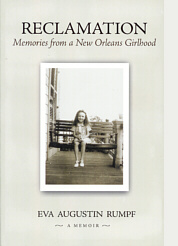
Reclamation: Memories from a New Orleans Girlhood
Reclamation: Memories from a New Orleans Girlhood by Eva Augustin Rumpf is set in the 1940s and 50s in America’s most “foreign” city. It takes the reader through World War II blackouts, Mardi Gras celebrations, sex myths, race relations, shotgun houses, shrimp boils, summers on the front porch, polio and whooping cough epidemics and hurricanes. A lost age is evoked of drugstore soda fountains, sidewalk games, street vendors, 78 rpm records, orange biographies, tepee motels, Woolworth stores, radio dramas, cod liver oil, party lines, the iceman, starched clothes and double features at the movies. Through childhood and adolescence we follow the author’s struggle to overcome the deprivations and limitations of her lower-middle-class life and her need to find identity and freedom amid her large extended family. Rumpf explores why she felt compelled to leave New Orleans and build a life away from her family and the city of her birth. It was only after the floods of Hurricane Katrina wiped out much of New Orleans and scattered her family that she realized how much had been lost. Through her memoir, she seeks to reclaim her personal past, even as the city continues its reclamation efforts years after the disaster.
~
Excerpt from Chapter 6, “The Silver Dollar”
As a 7-year-old, I didn’t know anything about investment strategies. But I learned that having a coin bank paid off. Mine was a tall tin can, designed to look like a round, red-brick chimney, with a slot on top for depositing coins. When I shook the bank, the coins inside made a loud rattle, proclaiming my wealth to all within earshot. I made sure my whole family knew about my chimney bank. When relatives would visit, I would bring it out and not so subtly coax visiting aunts and uncles to drop in a few pennies, or a nickel or two. Birthdays or other special occasions might bring forth a quarter. To a child growing up in the 1940s, a handful of change seemed like a fortune.
But a windfall I had not imagined came from my grandfather one day in the form of three silver dollars. Three dollars! I had never before received such a gift. I held them in my hand, feeling their heaviness. I rubbed my fingers over the raised face of Lady Liberty on each coin and the eagle on the other side. I was awed not only by the beauty of the large, shiny coins, but also by the thought of all they could buy.
 However, my frugal mother, schooled by the hardships of the Great Depression, made it clear that this gift was not to be spent. “You have to save it for the future,” she declared. So the three silver dollars went into my chimney bank, adding considerably to its weight and noise value. Over time, my assets rose and fell. Nickels and pennies often found their way to the corner grocery store to buy a pack of Juicy Fruit gum or candy cigarettes. A quarter might be spent for a Mother’s Day present or a new box of crayons. But the sacred silver dollars remained unspent, nestled in the bottom of my chimney bank, as secure as the gold in Fort Knox. Occasionally, I would take them out, turn them over in my hands, and contemplate their power and unleashed potential. The desire to spend my treasure was growing inside me like an infectious disease, uncontrollable and consuming. And it was fed by the pressures of the outside world.
When the lunch bell rang each day at my public grammar school, Frank T. Howard #2, my first-grade classmates and I would join the other students and trot down the well-worn wooden steps to the cafeteria. We’d line up along the wall and slowly snake our way to the serving window, where, for a few nickels, we’d get a hot lunch and a small carton of milk. Like most school lunches, the food was pretty ordinary. But after enduring the bland meat loaf or greasy chicken leg, lucky kids with extra money headed for the ice cream window. There, treats like crunchy Drumsticks, chilly Fudgesicles and luscious ice cream sandwiches were placed into eager hands.
I was not one of the lucky ones. To my mother, ice cream for lunch was an extravagance. She gave me only enough money for hot lunch and milk, and I carried the coins to school, tied in a corner of my handkerchief. As I watched the other students eating their treats, I longed to be a part of this privileged group. I wondered how many chocolate-covered Eskimo bars or orange Dreamsicles a silver dollar would buy. I began to plan my crime.
My chimney bank was kept on the bottom shelf of the big sideboard that stood against one wall of the dining room in the camelback house on Laurel Street that our extended family shared. I picked a morning when the room was empty, my father and grandfather having left for work, my hard-of-hearing grandmother busy in the kitchen, and my mother still asleep upstairs.
I slip quietly into the room, open the lower door to the sideboard, and lift out the bank. I pry open the removable lid and slowly tip the bank, sliding the silver dollars into my palm. I hesitate for a moment, considering the enormity of what I’m about to do. My parents will be horrified if they find out. I take one of the coins and drop it into my dress pocket. I return the other two to the bank, being careful not to let them clang on the bottom.
All morning at school, I think about the treasure I carry. From time to time, I slip my hand into my pocket and run my fingers over the silver dollar, savoring my secret. At last the lunch bell rings. I rush through my meal, return my tray to the counter, and walk up to the ice cream window. I hold power and prestige in my hand. The world is at my command.
I order a Drumstick, a crunchy waffle cone filled with vanilla ice cream and topped with a chocolate coating and chopped nuts, the most expensive treat in the cafeteria’s selection. I lay my silver dollar on the counter. When the Negro cafeteria worker sees the coin, she looks directly at me. I see surprise in her eyes, and I feel her reproach. Guilt battles with gratification. But it’s too late to undo the crime. In an instant, my silver dollar is gone forever. I leave the ice cream window with my prize in one hand and an assortment of ordinary coins in the other. I sit alone at a table in the cafeteria and try to enjoy my ice cream cone.
When I got home from school that day, I furtively returned the change to my chimney bank. The small coins looked meager beside the two remaining silver dollars. I never told anyone about how I squandered my grandfather’s gift, and over time my parents must have forgotten about the remaining dollars in my bank. But the feelings of loss and guilt created by my childhood indiscretion stayed with me for a long time. Well into my adult years, whenever I was tempted to buy something I felt I deserved, a struggle waged in my soul between the forces of desire and self denial.
____________________
Eva Augustin Rumpf grew up in New Orleans, attended college in the Midwest and eventually settled in Wisconsin. She is the author of the satiric novel Prot U (Booklocker.com 2004) and co-author of the self-help book Till Divorce Do Us Part (Glenbridge Publishing 1996). A former reporter and university journalism instructor, she currently lives in Milwaukee.
ISSUE 15 / SUMMER 2008
Dark Card
By Rebecca Foust
Texas Review Press, 2008
Reviewed by Bob Wake
The strongest poems in Rebecca Foust’s chapbook Dark Card are so very good that they carry the collection as a whole and lift the lesser poems by sheer force of brio. Working to powerful effect is the chapbook’s thematic unity. Foust’s now-grown son has Asperger’s Syndrome, a neurological disorder on the autism spectrum. The twenty-seven poems touch on the poet’s journey from rage to acceptance and wisdom, as well as charting her son’s developmental challenges and coping strategies as he moves into adulthood. Brilliant, but socially awkward and withdrawn, he suffers the inevitable bullying in elementary school (“they cornered him / behind the storage shed and stoned him / in a hail of green oranges”). Dark Card‘s poems are worry beads. Plaintive prayers. Foust’s love and concern for her son are never in doubt, but the emotions on display are wounded and rubbed raw. Sentimental or saccharine? Forget it. The author’s quietest observations are often barbed (“My son is gentler with moths / than people ever were with him”).
Foust is good at evoking for us both the outward behaviors and the inward mental processes that constitute her son’s experience of the world. In the poem “Asperger Ecstasy,” for example, she writes of the miscellany that snare his focus and cause him to “vibrate with joy”: “It can be cataloging washing / machine brands or the note variations in a symphony, / or committing to memory for joyous recounting / the entire year’s schedule for the El-train.” Her sense of wonder, even envy, is triggered in the midst of what we perceive as a deeply melancholic alienation from her son’s neurology: “Oh, never to grow bored or experience a numbing / sameness of things! To immerse consciousness / in the sensory present of a bottle cap flattened by traffic…”
A series of six extraordinary poems (“Too Soon,” “Palace Eunuch,” “That Space,” “Firstborn,” “Apologies to My OB-GYN,” and “No Longer Medusa”) early in the volume recount in harrowing, if at times oblique, detail what appears to have been a premature and difficult birth. Fueled by sulfurous sarcasm and remarkably controlled indignation, Foust unloads on incompetent medical staff and inattentive gods alike. Her poetic rants are among the highlights of Dark Card, typified by the opening two stanzas of “Apologies to My OB-GYN”:
Sorry that my boy birthed himself
too early, took up so much room
in your prenatal nursery
with his two pounds, two ounces
and did not oblige your nurses
with easy veins.Sorry we were such pains in your ass
asking you to answer our night calls like that,
and that he did everything so backwards:
lost weight, gained fluid
blew up like a human balloon
then shriveled.
Later poems in Dark Card shed their anger and evolve into a kind of beatific embrace of a gifted math-whiz son who “loves who he is.” In the poem “Like Dostoyevsky’s,” Foust writes: “My illiterate heart / is a mother’s heart that beats / and breaks by rote, but I’m learning / to let him alone and to see / that his pacing and humming / are how he keeps time / in a world made of chaos…”
The penultimate poem, “Empathy,” is a lovely encomium to Temple Grandin, famed autistic writer and researcher whose advocacy work on the ethical treatment of farm animals has led to industry-wide reforms in livestock handling. “Empathy” is a model of poetic precision, a complex, fully realized mini-biography of Grandin’s life as a veterinary scientist and as a person with autism. It’s also an example of how the collection’s poems, all of which stand alone as fine individual pieces, gain impact through their juxtaposition and sequencing. Dark Card is a masterful debut by an exceptional new poet.
____________________
Bob Wake is editor of Cambridge Book Review
Four poems by Sarah Busse
~
This Bed
The milk paint cannot be stripped from the wood,
rusts deeper into the grain with every year
as blood will stain a sheet, or fall, a hill.
This bed is all land, fertile and farmed, square
as an Iowa field and heavy with its burdens.
Not our first bed, that narrow dorm cot,
nor second, the handy frame you hammered for me.
This bed I dreamed my girlhood in becomes
our third, charmed and lucky, high
off the floor, a house’s secrets stowed between its legs:
a solid, home-carved trestlework, a fastness
made for a farmer’s bride two hundred years ago.
I think it filled her two-room house.
~
The Dreamer
We sailed around the world.
We sailed to land in Rome—
Now why would a pagan like me
Harbor a dream of Rome?
The next time it was your house.
(Again it was us two.)
And all the songbirds maimed—
I don’t remember more.
If I could have run away,
If I could have run, I’d run.
But I couldn’t, no, I couldn’t—
In a dream you never can.
A daughter’s cry awoke me,
Another call to love.
And as I tried to answer her
My legs still wouldn’t move.
If I could have run to her
If I could have run, I’d run.
But I couldn’t, and I cannot—
From a dream you never can.
~
Two Postcards to Sylvia
1.
I rise quietly to work in the still-dark dawn.
Like you. I do not love easily or well. Ardor
is a different matter.
Years ago in a dream the grass spoke to me,
saying You must find an
other way. Minus extremity’s rigid torque.
I am walking that way now, though I know
the moon desires her own devoted, grown
to reflect the shattered brilliance of the eye’s round.
2.
I tell you this shard of a dream to hold myself
by your ear, to keep from falling to the mud:
You, a white giant frozen
mid-stride into momentary flares of a storm.
Me, a tree-frog climbing, sticky-toed and soft,
up your marble thigh, along an arm. You were
not perfected. No, terribly not perfected.
Interrupted, there in the freezing mud.
Glaring into light that soaks us both.
~
A Wish for the Bride and Groom
The spring wind is a wedding guest
Strewing flowers across the grass,
Preparing the way for the bride and groom,
The lovely two who shall come to pass.
May all those I have loved, or ever
Wished to love, be at peace,
And your lives fill with grace
As this kind wind billows the sail
To carry us gently home.
______________________________
Sarah Busse is the co-editor of Verse Wisconsin. She has two chapbooks out, Quiver (Red Dragonfly Press, 2009) and Given These Magics (Finishing Line Press, 2010). She lives in Madison with her husband and two children.
Tuned Droves
By Eric Baus
Octopus Books 2008
Reviewed by Bob Wake
Denver-based poet Eric Baus has a style and a lexicon uniquely his own. It’s a poetry that feels free-associative but never arbitrary, rigorous in its use of recurring images and themes, and playful in a way that invites rather than discourages reader engagement. Tuned Droves at times takes on the dreamlike quality of a whimsical bestiary hovering between the symbolic and the three-dimensional, as in “The Convex Vulture Unearths Ventricles”: “The vulture continually recovers but its chambers are no longer its / own. Other barriers to circulation, such as the plural swan and its / apprentice, the spoon, dissolve in separate spheres.”
Or this, from “His Illuminated Ear”: “The new peacocks are known for speaking slowly in small, looping / script. It is my duty to look away from their fluorescent beaks …”
 Forged of a weirdly original blend of surrealism and linguistics, Baus’s work rewards both diligent and casual readers. Like eavesdroppers parachuted into an alternate universe or a mythical kingdom, we listen and watch for the patterns and repetitions that uncover a sympathetic correspondence within ourselves. Always lurking is the niggling suspicion that we’ve never left home: we’re seeing our own world stripped to sinew and bone courtesy of Baus’s x-ray vision. Here, for example, are two sentences, a small prose poem, the sole entry in a section of Tuned Droves titled “The Sudden Sun”: “When a boy’s mouth collapses into itself, tiny flames release from his / limbs. Although this is a small flash, he is startled by the sudden / sun.” Baus is especially good at capturing the profound immediacy of childhood, when self-consciousness is innocent and fresh, when every new insight feels like the universe opening up for us.
The seven brief untitled poems that comprise the section “I Know the Letters This Way” seem to emanate from a lyric voice in the process of becoming: “… I / was born and then I learned to swim and then I learned how to pro- / nounce the letters of the alphabet …” Water, amniotic and primordial, is both source and classroom: “I saw a blank. Then waves.” Archetypal figures with names like “Mrs. Hand” and “Miss Toy” and “a man whose name was a buckle” enter the slipstream of the poet’s consciousness: “They were born when they learned how to swim.” There is talk of an “accident,” perhaps one of those Gnostic incarnations beloved of Harold Bloom, humanity born into the lower, corrupt realm that is our lot on Earth. Poet as accidental tourist. Whatever the origin or outcome of the “accident,” Baus seems to suggest that we are redeemed through our connectedness to one another. “We have similar streams,” the emerging poet declares.
Elemental images appear and reappear throughout Tuned Droves—paper, wheat, bees, tongues, rain/water, sun, snow, swimming, man/woman/boy, speaking, singing—totems from a subterranean liturgy. An oracular voice surfaces in some of Baus’s poems, trance-like incantations of a prophet/scientist (Pascal, say, or Swedenborg), as in “The Emergence of a Wolf”: “The bee’s stinger is like an enclosed, dark tongue. The atonal tortoise / is a kind of dictionary in reverse. To see them is to feel one’s teeth / become abstract. They survive as obstacles to grammar and song. / They do not, then, accept the vibrations in an ear, for example, as proof of / sound. The drama of their wavelengths occurs just before the emer- / gence of a wolf …”
When Baus is firing on all cylinders there is an aching, psalm-like beauty to his work that is mystical yet emphatically concrete in its yearning, its humanness. The short poem “Inside Any Good Song Someone is Lost” is a small masterpiece of this form seemingly invented and perfected in the wondrously strange pages of Tuned Droves: “There is a splash. There is another splash. There is another. There is a / man a man two women a boy and a boy. Something else. Someone / else. I can’t see past the wheat and birds I can’t see. There is a singer. / Is there a second singer? There is. That is, you can record yourself from / the center of a parade. The clouds are large. You are little and the / clouds are so large.”
______________________________
Bob Wake is editor of Cambridge Book Review.
Origins of FIS (Factory in a Suitcase)
cbr 5 / winter 2000-2001
From Redshift: Greenstreem
By Rod Clark
CBR Press 2000
Appendix II
Selected Terms
from Encyclopedia Cybernetica
as of June 2nd, 2094
• Macroset
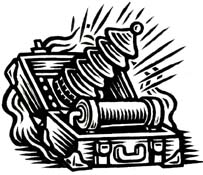
Factory in a Suitcase. (Illustration by Spencer Walts from "Redshift: Greenstreem.")
A macroset is a set of interdependent nanobots generally containing at least a billion nanobots whose operations are directed and coordinated by an AI matrix commonly referred to as a “hive.” Macrosets can be powered by a variety of means, including microfusion, old-fashioned microwave technology, and a multitude of biochemical reactions, in particular those related to the binding and unbinding of DNA molecules in bi-knit flow systems. The latter technology was combined in 2053 with human-derived DNA and neurotransmitters to produce an AI system that simultaneously powered and directed the newly invented micro-machinery matrices. Although such neurotransmitters and DNA matrices may be synthesized, the purest and most economic means of producing them is in human beings themselves, thus allowing a large portion of our planet’s population to earn a basic subsistence wage for doing almost nothing, and helping to solve the massive unemployment problem of recent decades.
The first experimental macroset was created by Engineer Jack Dougal McCool in 2042. He called it a “factory in a suitcase” or FIS, and stunned observers in the granite shield country near Rainy River, Minnesota by pouring an early FIS out of the back of a dump truck and having it carve part of a roadway through a half mile long granite shelf in less than three hours. This crude pilot model was nicknamed “the lamp.” It was set in motion not by an external switch, but by rubbing the titanium shell of the cylinder to excite and “wake” the blubit matrix, which then projected a tiny hologram avatar which requested verbal commands from the set “master.” It would then process the commands as riddles to be solved, and proceed with attempted solutions. Today, the macroset descendants of Jack McCool’s early FIS prototype can direct a wide range of nanotech “soups” to perform an astonishing variety of manufacturing or reengineering tasks at a high speed (and at any scale, including terraforming or metrostructing, depending merely on the size of the macroset and its parameters ). Today macrosets are capable of folding all their components into much smaller spaces with much greater capacity then was once contemplated. The massive FIS hives of the mid 21st century have given way to systems that can fit into a 5 kilogram attaché case. “Worldmaker” macrosets the size of McCool’s original FIS can now terraform and urban plat entire planetoids, complete with big box retail and Macrodonald arches from horizon to horizon in as little as forty-eight hours. All the marvelous achievements of macrosets are acomplished with essentially four kinds of bots: sensits, the eyes, ears and nose of the set; blues or blubits, which analyze, program and direct; quicks or quickets, which provide inter- and intra-energy transfer and communications; and redniks, which construct and deconstruct. These collaborate through the aforementioned system matrix called a hive.
 Once set in motion, a macroset can be a dangerous tool, since it has the ability to radically transform any matter in its path, creating an astonishing repertoire of buildings, machines, goods and artifacts of all kinds—limited only by the sources of energy and matter available for it to tap, and by the reins of its managing software. Because of its potential for destruction as well as construction (as demonstrated by the tragic art-deco redesign of Cincinnati in 2068), the security, development and improvement of management and control systems has always been the focus of macroset engineering as carried forward by the Greenet Consortium.
Even in the early days of macrosets there was a considerable controversy over the best way to develop guidance systems to manage, direct, and control the energies of trillions of molecular sized nanobots in order that they might perform the many complex and sophisticated tasks that nano engineers anticipated for them. McCool’s orginal FIS was an “evolved” AI system which grew slowly at first, matured rapidly into a brief and useful life, and then became unmanageable as its experience grew exponentially—requiring “macrocide” when the system matured, began to question, and eventually overwhelmed control systems. This early control design was built on the “democratic” hive concept—with each class of nanobots being assigned tasks which it could carry out in any fashion it liked within crudely defined parameters. The “education” process proved extremely difficult, as the creative bots periodically found inventive ways to subvert and overwhelm their parameters—sometimes, as noted earlier, with disastrous results.
The McCool theory was that this nursery method of cultivating and educating macrosets, although expensive and difficult in its early stages, would produce the finest macroset hive in the long run. Challenges included the uncertainties generated by chaotic variation and the difficulties inherent in calculating Brownian tolerances of nanobot matrices when such systems are allowed perfect freedom and maximum learning opportunities (within loosely structured strange attractor parameters). The expenses and danger inherent in this process, which McCool called “training the genie,” plus the reasonable doubts of Greenet Executives that total mastery could ever be achieved over such continuously evolving AI systems, combined to move the “control” initiative in a newly secure and responsible direction. AI queens were established to build security envelopes around macrosets and help commercial interests direct them with tighter discipline. McCool, more interested in science than safety, did not care for the new approach. Unfortunately, his irrational opposition to the new control protocols deranged him, leading him into the unconscionable criminal activities of the 80s, and tarnishing his reputation.
In the interests of greater macroset security and control, Greenet’s 20th century predecessor, a clumsy and loosely structured capital matrix called the Fortune 500, directed Lucent and other ancient firms to create “plug and play central” control systems that would send predefined (fully cooked) imperatives directly from corporate engineers to the systems—crisply separating the problem solving and execution modes of macrosets. However, this proved too restrictive to be economically viable, since such macrosets did not have the creative freedom to sufficiently modify projects when presented with unexpected anomalies or flawed instructions. After a number of tragedies resulted from this well-intentioned but over-restrictive approach—this too rigid format was abandoned. Hence today’s “Chinese Box” macros in which successively more heavily controlled layers of directly programmed security bots encase a free thinking hive like the layers of an onion. Within this secure corral, the macroset is allowed to “think” freely, but is only allowed to “act” when off-system approval of change options is granted. Vicious rumors that some macros have escaped their molecular prisons and are prowling loose on the moons of Jupiter and elsewhere at the Solsystem’s rim are entirely false. Greenet’s management of such systems is secure and absolute.
There are, however, a small handful of FIS lamps—created for the use of McCool and his criminal descendants—still believed to exist, operating irresponsibly free of Greenet. These systems were deliberately released into Solsystem by McCool following his conviction for subversion under the Greenet protrust laws of 2063, and subsequent escape from custody and disappearance among the moons of Jupiter in 2087. These include three lost lamps, and one experimental “ring” which disappeared with him and may be at this very hour in the hands of subversive elements that are either ignorant of the dangers of such self-energizing, continuously self-modifying units or are involved in criminal conspiracies to perpetuate their use. The control of these maverick macrosets, sometimes called the “Y” series, can only be exercised by an imprinted male who shares (by direct descent) the same “Y” chromosome as Jack Dougal McCool. If the reader has any knowledge of these “loose lamps,” or the location of any direct male descendants of Dougal McCool, it is that individual’s responsibility to report this information to the nearest Greenet terminal so that these individuals can be placed in protective custody, and these maverick macrosets can be tamed or deactivated, and made safe for the good of all.
Solsystem, into which we are locked until (or if) the FTL drive can spread Greenet across the dark matter between suns, has a finite and diminishing amount of matter and energy supplemented to some extent by solar and galactic radiations. The FIS lamp piracies which may now operate sporadically throughout solsystem, may be depleting this precious reserve of matter and energy, maintained by Greenet for the good of all, thus threatening the very foundation of civilization as we know it. Remember, energy not managed by Greenet is energy mismanaged: “Loose Lamps Lose Amps!” Be sure to report any information you come across regarding these maverick lamps or McCool descendants to Greenet Central. As the reader is no doubt aware, these maverick lamps are known as Aladdins.
Redshift: Greenstreem is available from cbrpress.com or Amazon.com.
____________________
Rod Clark is a life-long Wisconsin resident. A professional writer and media-consultant, he is also the editor of Rosebud, a national magazine for people who enjoy good writing.
Omens of Millennium
By Harold Bloom
Riverhead Books 1996
Reviewed by Bob Wake
(From cbr 2 / spring 1998)
 Harold Bloom, well into his sixth decade, exudes a lifetime of literary study and critical thinking, coupled with an irascible penchant for gnomic generalizations and grumpy political asides. Omens of Millennium—his 22nd book—manages to combine literature, religion, and politics in sometimes brilliant, sometimes baffling ways, which is to say it’s quintessential Bloom. While casting a disdainful eye on New Age spirituality in America, he presents us with a historical look at the rich religious traditions that form the basis for our fascination with angels, near-death experiences, and dream visions. Equally, Bloom defines his book as a “spiritual autobiography,” and interwoven throughout the text are references to his personal odyssey, including a breakdown at age 35 (“I got very wretched, and for almost a year was immersed in acute melancholia”) that first led him to study Gnosticism and find solace within its dark, existential spheres.
Born in New York City in 1930, he began his teaching career in 1955 at Yale (where today he is Sterling Professor of Humanities, in addition to a concurrent position at New York University as Berg Professor of English), and published his first book in 1961. Like Edmund Wilson before him—whom Bloom most resembles in his exuberant overreaching into subjects like religion and political history that lie outside his more assured literary purview—Bloom is often at his most interesting when making provocative, even outrageous assertions. But of course those very qualities which make Omens of Millennium quintessential Bloom are also those qualities which confound mainstream book reviewers, and incite critics like Michiko Kakutani in the New York Times to characterize the book as “an incoherent work—discursive, self-indulgent and a trial to try to read.”
Omens of Millennium above all is an encomium to Gnosticism, the profoundly heretical religious movement of the second century, C.E. So enraptured is Bloom with Gnosticism’s creative upturnings and reversals of traditional Judeo-Christian tenets, that he finds within its nose-thumbing paradoxes a sublime emphasis on individuality similar to Emersonian self-reliance. Bloom has been mining this territory for several decades now—the Gnosticism inherent in our American character—but Omens of Millennium goes even further, with Bloom outing himself as a full-fledged Gnostic and closing the book with a twenty-one page Gnostic “sermon,” in which he declares: “ ‘Thrown’ is the most important verb in the Gnostic vocabulary, for it describes, now as well as two thousand years ago, our condition: we have been thrown into this world, this emptiness.”
If the phrase “we have been thrown into this world” seems to echo the existential philosophy of Martin Heidegger, there is good reason for this: the book which inspired Bloom’s Gnostic conversion 30 years ago was The Gnostic Religion, originally published in 1934 by Heidegger’s pupil Hans Jonas. The thrust of Bloom’s theology takes off from Jonas’s now famous epilogue appended to the 1958 edition of The Gnostic Religion and titled “Gnosticism, Existentialism and Nihilism.” A remarkable synthesis of Gnostic thought with the philosophies of Heidegger, Nietzsche, and Kierkegaard, Jonas’s epilogue continues even today to influence readers with its unique perspective, blending as it does cultural pessimism with personal transcendence. It presents a far more radical interpretation of Gnosticism than, say, Elaine Pagels’s extremely popular, but sanitized and New Age-ish The Gnostic Gospels (1979).
To the extent that an “essential” Gnostic philosophy can be distilled from its many strains and off-shoots, it appears at heart to suggest a deep distrust of religious and political institutions and authority. Gnosticism preached that the God of Judeo-Christian tradition—the God of the Bible—was an imposter, an insane “demiurge” who sloppily created our false reality of flesh and sorrow, and who has no relation to the true Supreme Being whose existence is distant and removed from our corrupt world.
Bloom believes that the Gnostic paradigm offers the only cogent explanation for the existence of evil, which is described as stemming from the psychotic demiurge who created our world, rather than the real God, the estranged creator:
The transcendent stranger God or alien God of Gnosticism, being beyond our cosmos, is no longer an effective force; God exists, but is so hidden that he has become a nihilistic conception, in himself. He is not responsible for our world of death camps and schizophrenia, but he is so estranged and exiled that he is powerless. We are unsponsored, since the God of this world, worshipped (as Blake said) by the names of Jesus and Jehovah, is only a bungler, an archangel-artisan who botched the False Creation that we know as our Fall.
Gnosticism encouraged the idea that within each of us is a divine spark connected to this “alien” Supreme Being. The Gnostic mandate is thus to reveal and nourish the divine spark and manifest our true spiritual origins. The theme of “hidden truth” is common of course to innumerable varieties of mysticism, alchemy, and Kabbala, as well as “secular” enterprises such as Freudian and Jungian psychoanalysis. New Age spirituality, too, promises its adherents a glimpse into deeper, more “authentic” realms.
Harold Bloom has little patience for the New Age, which he sees as a debasement of religious and literary history. He appreciates the yearnings that give rise to spiritual trends and fads, but he believes that Americans today are seeking easy answers to difficult questions of faith. Our current obsession with angels, for example, he finds particularly shallow:
To find your angel is not necessarily to find yourself, though most quests for the angels seem nowadays to suppose that a guardian angel is rather more like a dog or cat than like a husband or wife. You acquire an angel in the expectation that this addition to your household will give you perpetual and unconditional love.
Bloom wants to restore to us the terrifying grandeur with which angels, as well as dreams and near-death experiences, have been portrayed in the distant past. To this end, he guides us through complex Gnostic myths and fascinating interpretations of Jewish, Islamic, and Christian literature, as well as the works of John Milton and William Blake, both of whom he’s written on extensively over the years. Bloom is clearly revisiting some well-trod paths of his previous books, but he is a master at reconceptualizing his observations and placing them in fresh contexts. His life-long interest in Freud forms the basis for the brilliant chapter, “Sigmund Freud’s Dream Book,” which locates The Interpretation of Dreams within a framework of mysticism and hermeneutics.
Is Omens of Millennium a great or essential book? Perhaps not. It is, however, a fine showcase for one of our very best “readers.” Bloom’s textual interpretations are always deft and enthusiastic, and he is equally at ease with Shakespeare or Freud, the Book of Daniel or Paradise Lost. The most damaging flaw of Omens of Millennium is the book’s lack of a bibliography and index, not to mention footnotes, all of which would have been useful, and without which the book is rendered rather hopeless as scholarship. There are dozens of intriguing sources that Bloom alludes to or quotes from throughout his book, but the quotations—sometimes lengthy—are minus citations of any kind. Bloom’s arguments are never less than fascinating, but Omens of Millennium has the slapdash feel of a project written and published quickly to cash in on the very same rapacious New Age marketplace that Bloom lambasts so vociferously in the pages of his book.
____________________
Bob Wake is editor of Cambridge Book Review.

cbrpress.com

coffeespew.org
 cambridge book review